

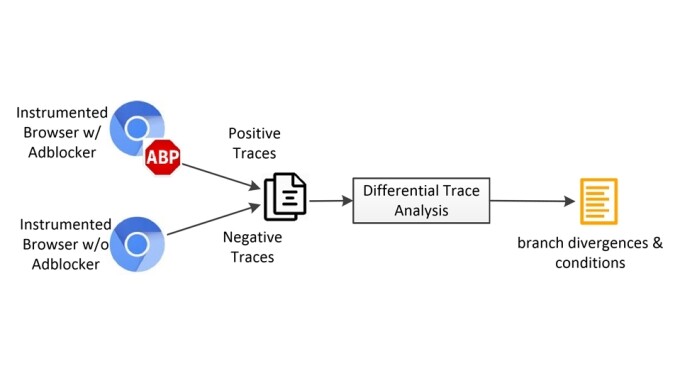
LOS ANGELES — A new report by researchers at the University of California, Riverside; Syracuse University; and the University of Iowa, titled, “Measuring and Disrupting Anti-Ad Blockers Using Differential Execution Analysis,” is shedding light on the often-secretive measures taken by top websites to thwart ad blocking software installed on consumers’ computers.
The rise in ad blocking is one of 2017’s top concerns for online advertisers and publishers, and a trend that is certain to continue into the future, putting action plans on the front burner for 2018 and beyond, as today’s e-commerce ecosystem struggles to regain revenue lost to ad blockers.
According to the report, while millions of people use adblockers to remove intrusive and malicious ads as well as to protect themselves against tracking and pervasive surveillance, online publishers consider adblockers a major threat to the ad-powered “free” web.
“[Publishers] have started to retaliate against adblockers by employing anti-adblockers which can detect and stop adblock users. To counter this retaliation, adblockers, in turn, try to detect and filter anti-adblocking scripts,” the report said. “This back and forth has prompted an escalating arms race between adblockers and anti-adblockers.”
The report’s authors are seeking to develop a comprehensive understanding of anti-adblockers, with the ultimate aim of enabling adblockers to bypass state-of-the-art anti-ad blockers. Presenting a differential execution analysis to automatically detect and analyze this evolving technology, the authors’ collected execution traces by visiting websites with and without ad blockers.
“Through differential execution analysis, we are able to pinpoint the conditions that lead to the differences caused by anti-ad blocking code,” the report said. “Using our system, we detect anti-adblockers on 30.5 percent of the Alexa top 10,000 websites, which is [5 to 52] times more than reported in prior literature.”
The report notes that unlike prior work which was limited to detecting visible reactions (e.g., warning messages) by anti-adblockers, this new approach can discover attempts to detect adblockers even when there is no visible reaction.
“From manually checking one-third of the detected websites,” the report explained, “we find that the websites that have no visible reactions constitute [more than 90 percent] of the cases, completely dominating the ones that have visible warning messages.”
Based on these findings, the authors intend to further develop JavaScript rewriting and API hooking based solutions (the latter implemented as a Chrome extension) to help ad blockers bypass state-of-the-art anti-ad blockers.
“We believe it is crucial that adblockers keep pace with anti-adblockers in the rapidly escalating technological arms race,” the report concluded. “Our work represents an important step in this direction.”